10 Years of 100esperte: Women Experts Nearly Double Their Presence in Italian Media
The 100esperte project, which is part of the ENWE network, is celebrating its 10th anniversary. What better way to mark the occasion than by looking ahead and opening up new horizons?
Created to increase women’s presence in the Italian media as authoritative, knowledgeable sources, the database grew out of an idea by GiULiA, an Italian association of women journalists, and the Pavia Observatory, a research institute specializing in media analysis. It was developed by the Bracco Foundation. Today, it features 500 expert profiles, with more to come.
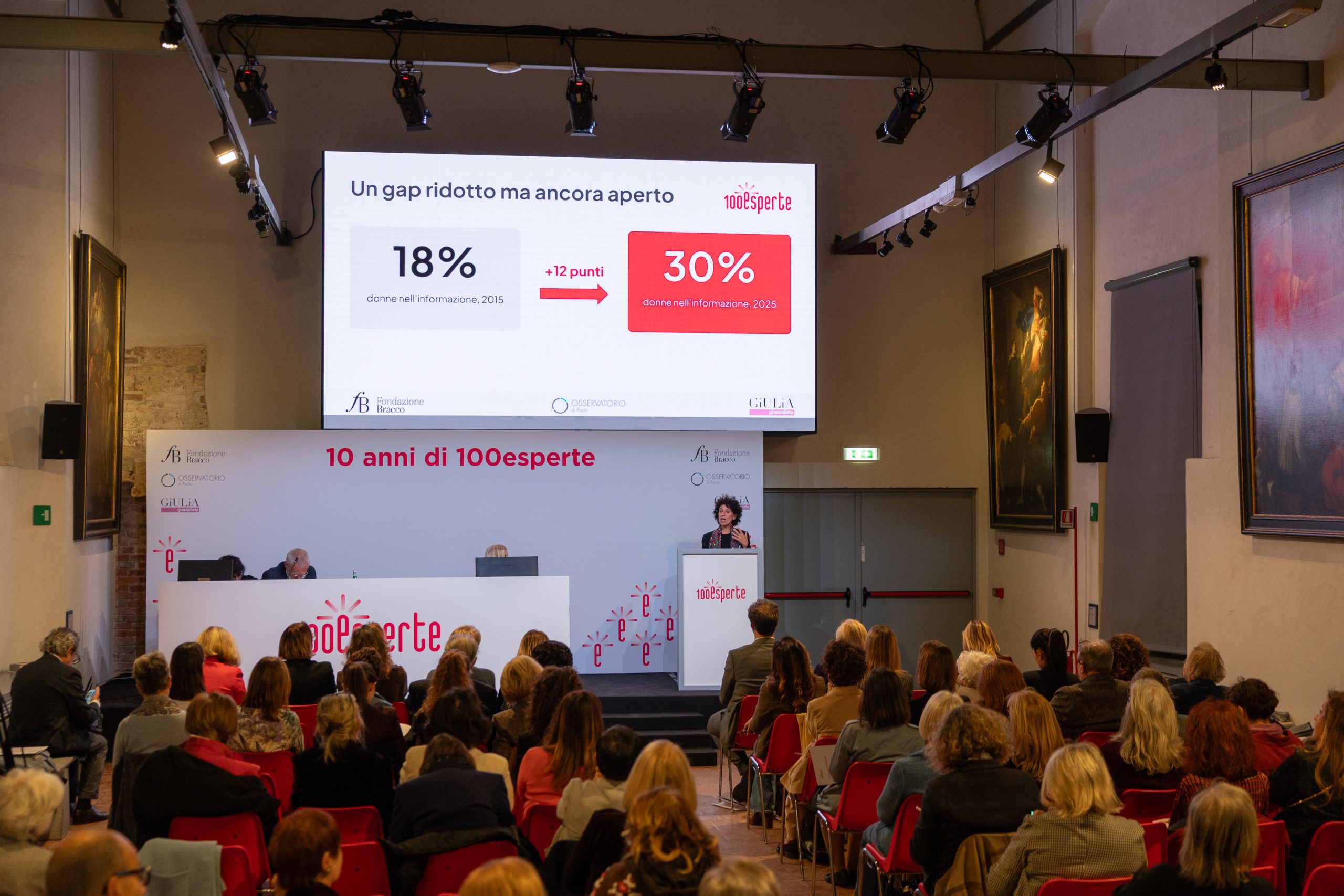
The anniversary was marked on November 3 at the Museo Diocesano in Milan with a special event titled “10 Years of 100esperte: Mapping Knowledge, Mapping Power.” The event offered an opportunity to reflect on the project’s achievements and launch a new chapter, with the addition of a Geography section and a redesigned website aimed at making it easier and faster to find experts, including through AI-powered search.
A lot has changed since 2016. GiULiA journalists Giovanna Pezzuoli and Luisella Seveso, together with Monia Azzalini, a researcher at the Pavia Observatory, started with the findings of the 2015 Global Media Monitoring Project (GMMP): women accounted for just 18% of the experts consulted by Italian media.
What was needed was a simple, accessible tool that journalists could turn to whenever they needed a qualified voice to comment on a news story or help explain a complex issue.
But the project also needed clear selection criteria, a scientific committee, and partners willing to support the initiative. First came the European Commission, followed by the Bracco Foundation.
The database began with its first field, STEM, featuring women scientists. Roughly every two years, new fields followed: economics, international politics, history and philosophy, and sports. The project gained the support of institutional partners, including the Italian Order of Journalists, Rai (Italy’s public broadcaster), and the European Commission Representation in Italy.
Over the years, a wide range of initiatives followed: training courses for journalists, where women experts explored current issues and built connections with media professionals; photography exhibitions; and educational activities for schools developed by the Bracco Foundation. All shared the same goal: to create more space for women’s perspectives and bring greater balance to the voices called upon to interpret the world.
According to the Global Media Monitoring Project, the share of women among experts featured in Italian media rose from 18% in 2015 to 30% in 2025. Initiatives like 100esperte have contributed to this progress, but a significant gap remains: women still account for fewer than one in three expert voices in Italian media.
That is where the project’s mission remains essential, and why its expansion into geography is particularly timely. The new section adds experts whose knowledge can help explain some of today’s most pressing issues: climate change, urban transformations, resource management, migration, cultural landscapes, and the geopolitics of territories.
The impact of 100esperte extends beyond Italy. Its experience helped lay the groundwork for the European Network for Women Excellence (ENWE), launched by GiULiA to connect databases of women experts across Europe and make their expertise more accessible to journalists internationally.
Through Ask Women, a monthly newsletter featuring women experts from different European countries who can comment on current affairs, ENWE helps journalists discover new sources and bring more diverse perspectives into their reporting. The newsletter currently reaches 770 journalists internationally.
The new Geography section of 100esperte will further expand the range of expertise available through the network, giving journalists access to Italian women geographers working on some of today’s most pressing issues.