Gender Equality in the Media: Northern Europe Leads with 40%, Greenland Surges Ahead
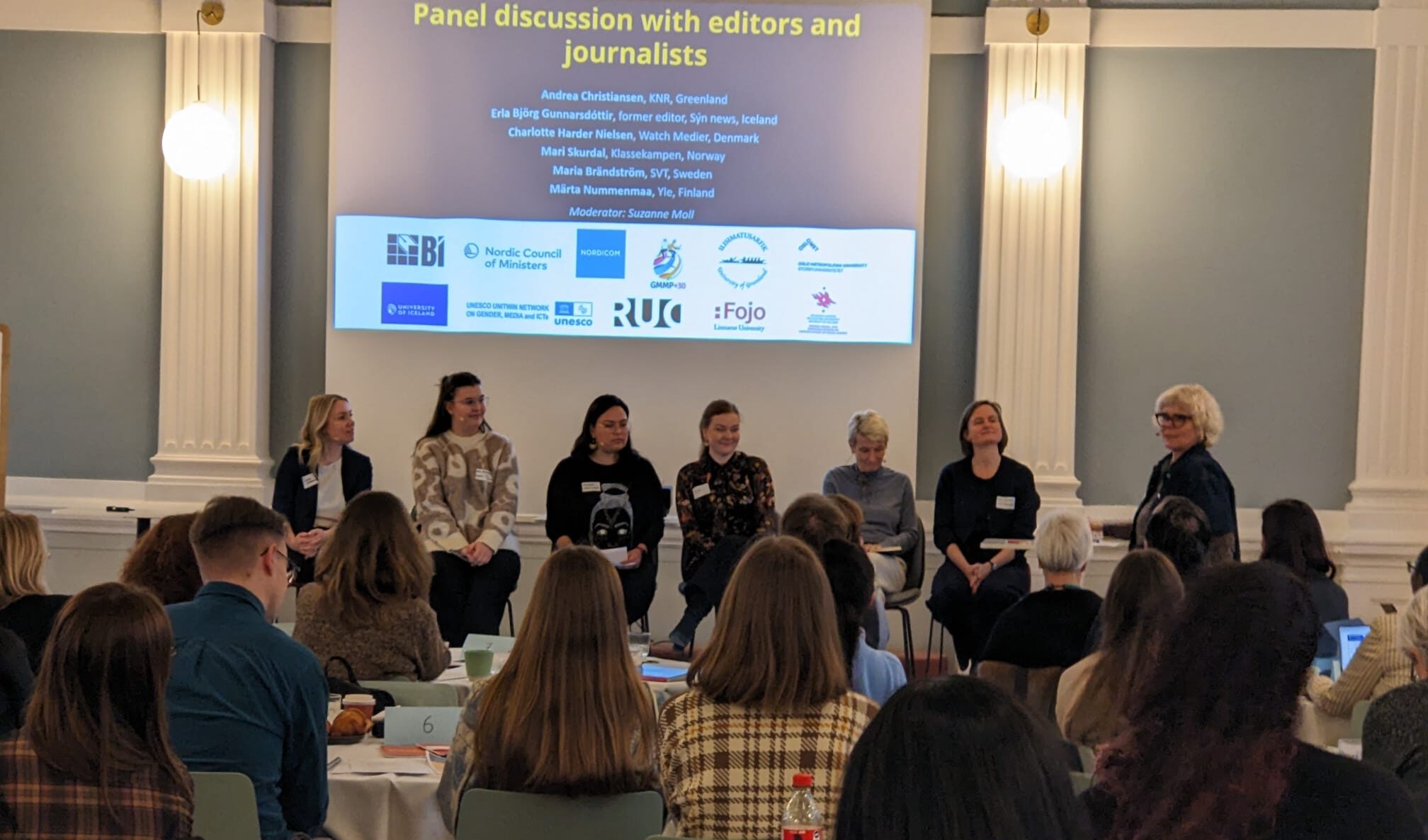
An opportunity not to be missed to take a look at the state of gender equality in the media of Northern European countries according to the Global Monitoring Project 2025: we took part in the Danish summit Who Makes the News?, organized by the University of Iceland together with the University of Helsinki, the University of Greenland, Linné University, OsloMet University and Roskilde University.
Researchers, journalists, editors, policymakers and representatives of civil society met in Copenhagen on February 5 under the supervision of Professor Maria Edström, professor of journalism at the University of Gothenburg, to present global and Nordic results, share best practices and strengthen collaboration. We presented our ENWE project in the “best practices” section, and the idea of a database of women experts and the European network connecting them generated strong interest in places where it did not seem necessary. Also present were Mateja Malnar Stembal, coordinator of Ona Ve, Slovenia, who presented the positive results of the work developed from the database, already part of ENWE, and Professor Claudia Padovani, a leading expert on gender issues and our Ambassador, who presented, among other things, the results of the programs of EIGE, the European Institute for Gender Equality.
The analysis of GMMP results in the Nordic countries showed a fairly positive situation, but also highlighted, as already noted, a tendency to maintain the status quo rather than to improve.
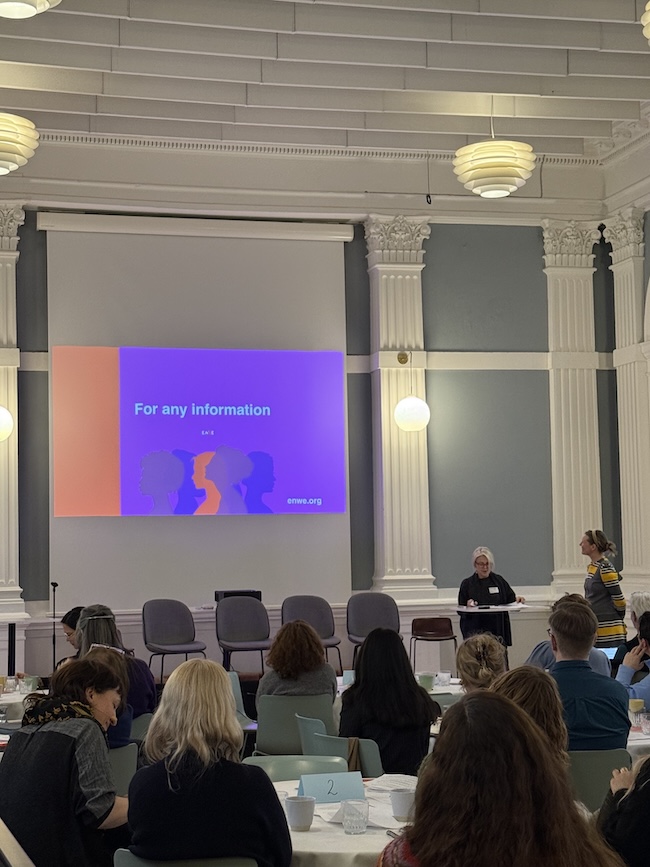
This was confirmed in the opening session by Sarah Macharia, a feminist economist, who explained that the analysis of the past thirty years, since the beginning of the GMMP study, shows a clear pattern: small but steady initial progress followed by a long phase of stagnation. The most recent results confirm this stability, with no significant regression in the main indicators, but with an overall flattening trend. This is worrying, especially in the current geopolitical context, where movements opposing women’s rights and gender equality are growing, with the risk of global backsliding.
A detailed analysis of Northern European countries aligns with this inertia: no Nordic country except Greenland has consistently exceeded the 40% threshold of female presence in the news to date. Thus, in Iceland, where women account for 38% of media presence, despite their significant presence in public and political positions, women continue to be underrepresented in economic and financial sectors. The labor market remains segmented, and the results show that formal representation is not enough to guarantee balance in the media. Over time, Iceland has celebrated its strong performance in the Global Gender Gap rankings, but has overlooked less positive indicators.
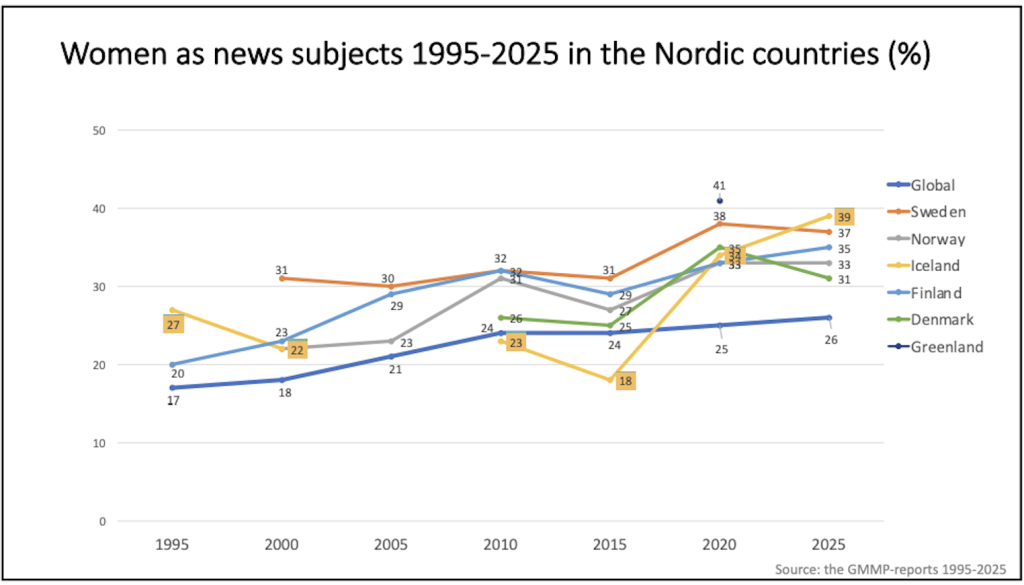
In Greenland, as mentioned, the situation appears relatively balanced: 41% of news sources are women. In politics there is numerical balance. However, traditional patterns persist: men dominate economic news, while women appear more often in cultural or social fields.
In Sweden, significant progress had been recorded between 2015 and 2020, but recently a slight decline and flattening of the trend has been observed. The data stands at 37%. There is talk of a “glass ceiling”: surpassing one-third female presence in news content seems difficult, and progress is not stable without constant effort.
In Norway, too, the data shows stagnation, despite greater awareness among newspaper editors. Although the government formally respects gender balance, the most visible political figures are often men. It is suggested that the growing presence of women in journalism schools and in online media may positively influence content in the future, but there remains a strong reliance on male elites as primary sources.
In Finland, the percentage is around 35% in traditional media and slightly lower when including online news, despite high female representation in Parliament and Government.
Denmark represents a relatively positive story. Over time, editors’ attitudes have changed: initially there was resistance, with the argument that media simply “reflect reality.” Today many newsrooms actively monitor their own data and acknowledge the existence of a “ceiling,” which over the years has led to fluctuating trends between 30% and 40%. However, even the presence of a female prime minister has not produced a decisive impact on media representation.
The data shows that women remain underrepresented as experts in news coverage and are often more present as spokespersons than as recognized authorities. Even in Northern Europe, therefore, the number of women consulted for their expertise is rather low: according to the GMMP report and press analyses, only about 20% of people interviewed in the media as experts are women.
To conclude with comments on the Nordic results: in political and international news, female presence is lower than their actual representation in institutions, and sometimes there is a kind of compensation through a higher number of female presenters, but not of female sources.
Another common issue raised was age: women tend to be less present in older age groups, both as subjects of news stories and as journalists. This is a global issue that should be addressed.
Finally, it was emphasized that the data, as in every country in the world, is based on a single day of monitoring and is subject to current events: on June 6, 2025, for example, there was extensive coverage of a sports scandal in Norway involving male protagonists; in Italy there was the Conclave; and elsewhere topics usually covered by male journalists certainly influenced the data. Therefore, the results do not represent an absolute truth, but they are useful indicators to stimulate reflection, research and change.
That said, no country has ever recorded a situation in which men are a minority in the news. And that is an unequivocal fact.
For more information:
conference website (under “Video recordings” and “More resources)
By Luisella Seveso